How earlier consideration of delivery strategy helps formulation teams understand trade-offs, preserve flexibility and shape the treatment experience
Pharmaceutical teams consider device strategy at different stages of formulation development. Whether meaningful delivery options remain open or have already been narrowed by earlier formulation decisions, teams arrive at the same question: “When is the right time to start thinking about device strategy?”
We propose the following hypothesis to address the emerging challenges associated with increasingly complex formulations: For complex drug products, device strategy and exploration should begin while formulation pathways are still being established. Formulation teams need visibility into how their decisions may influence the eventual treatment experience.
We call this Delivery Minded Thinking.
When it comes to realizing a therapy’s full value potential, the greatest risk is often not selecting the wrong delivery device. It is discovering too late that formulation decisions have already narrowed the range of delivery experiences that could have been technically feasible, more acceptable to users and of greater commercial value.
When a formulation aligns with an established pattern of administration, a platform solution is often the most logical route forward. Platform devices can reduce development risk, shorten timelines, simplify regulatory pathways and provide a familiar user experience.
As formulations evolve, however, formulation decisions can influence both delivery feasibility and the intended treatment experience.
A platform device may still prove to be the right solution, but an important question is whether its capabilities accommodate the emerging formulation and intended treatment experience, or whether the remaining constraints point toward an adapted, bespoke or hybrid solution.
When we engage with teams in the early stages of development, discussions often begin with what must be true for the formulation to deliver therapeutic benefit. That remains a critical consideration, but it is only one dimension of the treatment experience. Equally important questions include:
- Which aspects of the treatment experience might discourage long-term adherence?
- What is required to ensure treatment can be delivered safely, intuitively and consistently?
- How can the device help the treatment fit more easily into everyday life?
These questions become increasingly relevant as formulations become more challenging and begin to test the boundaries of established delivery platforms. For example:
- Higher-concentration formulations may reduce dosing frequency while increasing viscosity and delivery force.
- Larger volumes may preserve formulation stability while requiring longer administration times or a wearable device.
- Less frequent dosing may improve adherence in principle while creating a more demanding administration experience.
As these complexities increase, formulation and device decisions become increasingly interdependent. The drug product is not simply placed into a delivery system at the end of development. Rather, it becomes part of a wider therapeutic system in which clinical objectives, formulation characteristics, device performance, user capability and treatment workflow must work together. The goal is not only effective delivery, but delivery through an experience that patients and healthcare systems can realistically sustain.
This is relevant for injectable and inhaled therapies, where device complexity can further influence the challenge of self-administration.
Patients do not experience formulations. They experience treatment regimens. The effectiveness of a therapy depends not only on successful delivery of the molecule, but also on the practical realities of using the treatment over time.
Figure 1 illustrates this relationship. Formulation and device decisions influence both delivery effectiveness and the tolerability of the treatment experience.
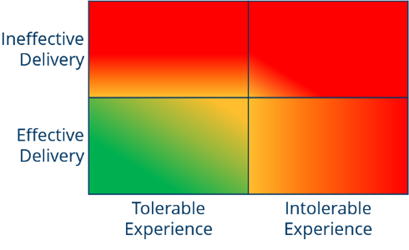
Figure 1. Effective delivery versus treatment experience
Patients must follow a treatment regimen in which storage requirements, preparation steps, training, administration processes, treatment frequency and the delivery device itself all shape the effort required to fit therapy into everyday life. Patients rarely see the complexity behind those decisions, and development teams do not always see the day-to-day realities of adhering to a therapy.
This distinction matters because two therapies with similar clinical propositions can feel very different in practice. One may be quick, discreet and intuitive, while another may require lengthy preparation, multiple handling steps, extended administration times or support from a caregiver. For chronic therapies, those differences accumulate over time and can influence confidence, adherence and overall treatment burden. They may also affect healthcare system workload and the feasibility of shifting care from the clinic into the home.
Another important consideration is the difference between first use and repeated use. Development teams naturally focus on whether a user can complete a task successfully for the first time. However, treatment success often depends on what happens later, when training has faded, routines have changed and treatment has become part of everyday life. Small difficulties that appear manageable during testing may become more significant over months or years of use. Training decay or small deviations in technique may undermine confidence, correct use and long-term adherence.
Across injectables, inhaled therapies and other delivery routes, the underlying principle remains the same. The product that reaches the market is not simply a molecule, formulation or container. It is part of a treatment experience shaped by a series of scientific, engineering and human-centered decisions. The objective is not to eliminate user burden entirely, but to understand where that burden exists, whether it is proportionate, and where it can be reduced through earlier consideration of formulation, device and use.
Consider this scenario: A company identifies a promising molecule, and formulation development progresses largely independently. Dose, concentration, viscosity, administration requirements and stability become fixed. A device team is then asked to identify an appropriate delivery solution. At that point, the preferred delivery experience may no longer be technically achievable. Additional engineering effort may recover incremental usability improvements, but compromises may still be required. The program may reach the market successfully, yet opportunities to create a more valuable treatment experience may already have been lost.
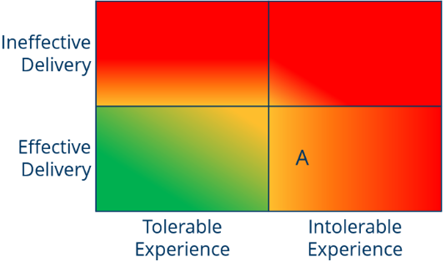
Figure 2. Suboptimal therapeutic experience illustrating where Company A has landed
We use the term ambitious to describe programs seeking meaningful differentiation through optimization of formulation, device, patient experience and workflow. The earlier these interactions are explored, the greater the opportunity to preserve meaningful choices and understand the associated trade-offs. As development progresses and uncertainty is reduced, those choices inevitably narrow. The objective is not to prevent that narrowing, but to ensure it occurs with a clear understanding of the implications.
That is the essence of Delivery Minded Thinking.
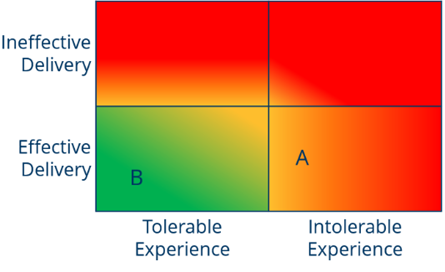
Figure 3 – Position of Company B illustrating the potential landing space of an ambitious program compared with Company A
What Early Device Engagement Provides
Early device engagement is a learning exercise. It helps teams understand which delivery options remain viable, which assumptions may constrain the treatment experience, and where flexibility should be preserved as evidence evolves. This is valuable whether a program adopts an existing platform, adapts one or develops a bespoke solution.
This can be achieved by mapping potential delivery technologies against emerging formulation pathways and examining the relationships between dose volume, viscosity, delivery time, storage conditions and user workflow. Formative research can then test what patients, caregivers and healthcare professionals can realistically tolerate. Together, these activities establish the delivery options available at each stage of development and the practical implications associated with them.
No process removes uncertainty entirely. The value of Delivery Minded Thinking is that it creates a shared basis for decision-making as evidence evolves and trade-offs become clearer.
Even when formulation development is already advanced, this approach can help teams understand remaining constraints, assess available options and identify where targeted changes to formulation, workflow or device requirements may still improve the treatment experience.
Conclusion
Formulation remains central to therapeutic success, but when delivery strategy is considered too late, opportunities to improve the treatment experience, reduce future rework or create meaningful differentiation may be lost before they are fully understood.
For many products, a platform device may ultimately be the right answer. The important question is not which solution a program selects, but whether teams develop the understanding needed to make that choice deliberately: how formulation characteristics shape the delivery experience, where device constraints exist, and which assumptions should remain open as development progresses.
That is the value of Delivery Minded Thinking: not choosing a device earlier, but making better-informed formulation and device decisions while meaningful choices remain open.